How Much Is a Fake Site Costing Your Casino Each Month?
No honest industry average exists, and we do not invent one. The figure comes from your own data, so your CFO can check every line.
By Delee Research · Published · 5 min read
A fake copy of your casino site costs you the players it takes from searches for your name. Four numbers your team already has turn that into a monthly figure in about 10 minutes.
For one fictional casino searched 50,000 times a month, the same fake costs USD 3,000 or USD 400,000 a month. The answer depends on numbers only the casino knows, which is why no honest industry average exists.
How one fake on a Google results page turns into a monthly cost
Key findings
- USD 3,000 to USD 400,000 a month. The same fictional casino and the same fake, under low and high assumptions.
- About USD 76. Online revenue per player per month at Flutter (FanDuel, Paddy Power, Betfair) in 2025: a public benchmark for what a player is worth.
- USD 0 vs USD 1,500. A Google notice is free; a domain dispute starts at USD 1,500. Even the low case covers the dispute within a month.
How a fake site costs you money
A fake site is a copy of your casino's site, on another domain, that takes logins or deposits under your name. Some people searching for your brand click it, and some of them deposit there.
So the monthly cost is four numbers multiplied:
| Number | Where it comes from |
|---|---|
| Searches for your brand a month | Google Search Console |
| Share of those searches that click fakes | The drop in your own clicks |
| Share of those visitors who deposit | Your analytics |
| What a depositing player is worth a year | Your finance team |
An example we follow through this guide. ExampleBet, a fictional casino, is searched 50,000 times a month. A fake on examplebet-vip.example ranks second for "examplebet", right under the real site, offering a 300% bonus.
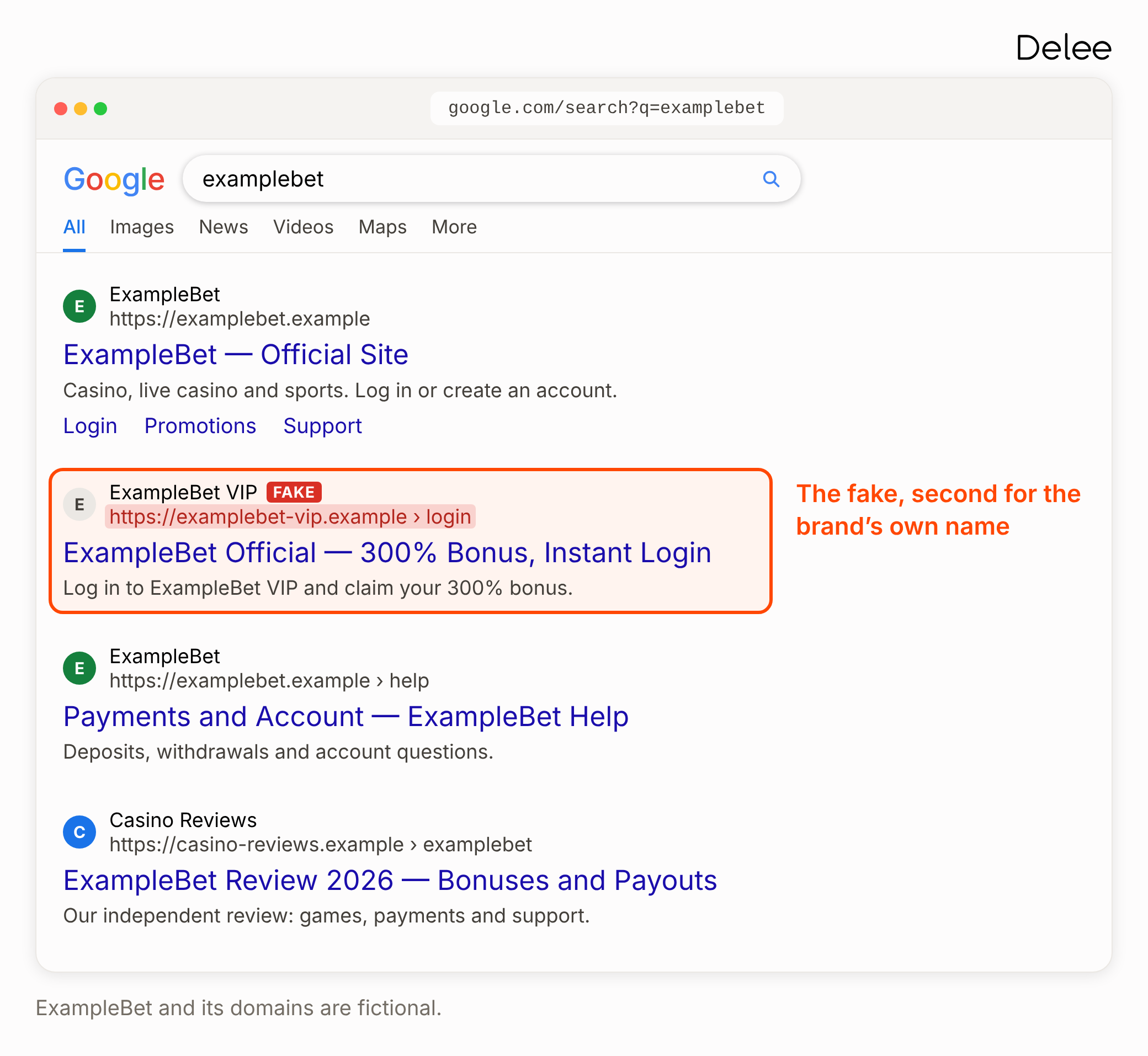
The fake ranks second for the brand's own name, between the real site and its help page
Where each number comes from, in 10 minutes
A first figure in 10 minutes
One pass through the systems your team already uses
- Searches for your brandSearch Console, Performance, last 3 months: impressions for queries containing your brand, divided by 3.2 min
- Share that click the fakeYour brand clicks in the weeks the fake ranked, against the weeks before. The drop, as a share of searches.3 min
- Share who depositVisitors from brand searches who deposit within 30 days, from your analytics.2 min
- A player's valueNet revenue per depositing player over 12 months: the figure finance already reports.2 min
- Multiply the fourKeep each number's source beside it, so anyone can check the figure.1 min
Search Console counts an impression each time your site "appeared in Search results"; for your own name, that is close to the number of searches.
No public data measures how many clicks a fake takes on a brand's name, so the second number comes from your own clicks.
What a player is worth: a public benchmark
Flutter, the owner of FanDuel, Paddy Power and Betfair, reported "15.9 million Average Monthly Players" and USD 16,383 million of revenue for 2025, 88% of it online. That is about USD 76 of online revenue per player per month.
One operator, two markets: a player's month is worth USD 84 or USD 149
Flutter revenue per average monthly player, per month
- US, Q4 2025
- USD 149
- Group, 2025, online only
- USD 76
- International, Q4 2025
- USD 84
Source: our division of Flutter's revenue by its average monthly players, 2025 results, published 26 February 2026. Players are counted online only; the group figure uses Flutter's 88% online share, and the quarterly market figures include retail shops. One quarter is seasonal.
Even inside one operator the value nearly doubles between markets (Flutter's 2025 results), so a borrowed figure misleads.
ExampleBet: USD 3,000 or USD 400,000 a month
ExampleBet is fictional, and every number below is an assumption chosen to show the range.
| Case | Low | Middle | High |
|---|---|---|---|
| Clicks | 1% | 4% | 8% |
| Deposits | 3% | 5% | 10% |
| Value | 200 | 500 | 1,000 |
| Cost | 3k | 50k | 400k |
Clicks and deposits are shares of the 50,000 searches and of the visits to the fake. Value is a player's year in USD; cost is USD a month, in thousands. In the middle case, 2,000 searchers reach the fake and 100 deposit there.
Any "average loss" quoted without these numbers hides a range this wide.
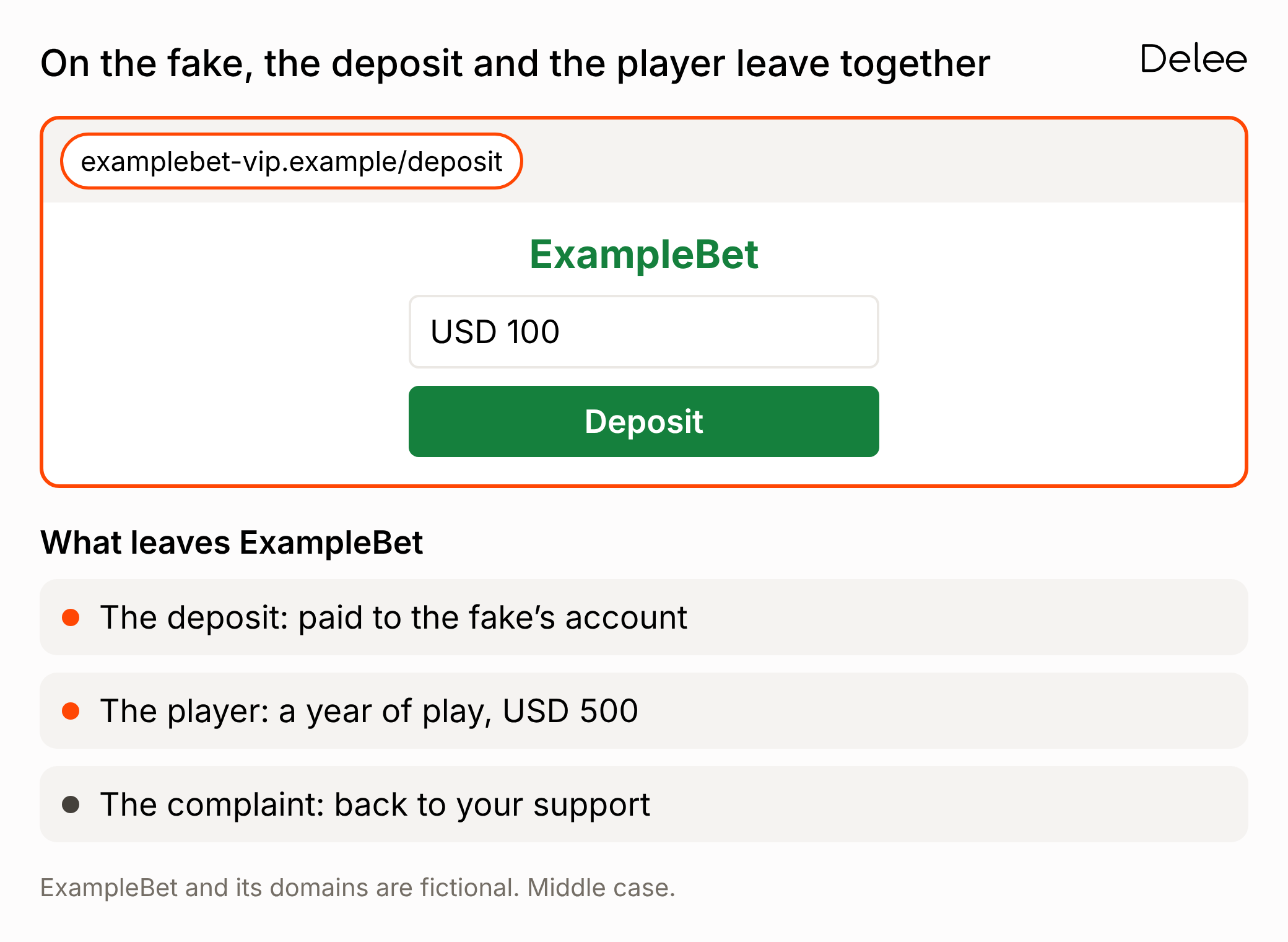
The deposit lands in the fake's account, and the player may not come back
The figure counts a year of each lost player; if half of them come back, the cost halves.
What removing the fake is worth
The number a brand can change is how many searchers reach the fake. The UK Gambling Commission measured what its actions did to illegal gambling sites' traffic in its October 2025 report.
In the middle case, a Google removal is worth USD 15,000 a month
ExampleBet's USD 50,000 a month, times the average traffic cut after each action
- Removed by Google (−30%)
- USD 15k
- Removed by Bing (−52%)
- USD 26k
- Blocked by registrar (−91%)
- USD 45.5k
Source: UK Gambling Commission, illegal gambling sites actioned from December 2024, SimilarWeb estimates, published October 2025; ExampleBet is fictional. Estimates: actions overlap, and the registrar figure rests on 8 sites.
These figures cover unlicensed operators, not copies of a brand; they are the only public measurement we found.
| Route | Fee | Effect |
|---|---|---|
| Google notice | Free | Off Google |
| Host report | Free | Offline, if they act |
| UDRP | USD 1,500 | Domain moves |
UDRP, the domain dispute route, is a fast arbitration that can transfer a domain using your trade mark to you. It costs USD 1,500 for one to five domains, per WIPO's fee schedule, and the domain moves only if the panel agrees.
A notice covers only your own content or trade mark; a knowingly false one carries legal liability under US copyright law (§512(f)). Each route is in how to take down a fake website.
What the figure leaves out
The figure counts lost revenue only, so the real cost is higher:
- Complaints. Players scammed on a fake contact the real brand; see a player is scammed on a fake.
- Your licence on the fake. A fake may show the real brand's licence number; see your licence on a fake.
- Fake apps and fake support. Players are caught outside search too; see brand impersonation beyond search.
It can also count too much: not every visitor to the fake would have deposited with you.
When fakes return on new domains every week, counting them by hand stops scaling. Delee helps brands find the fakes that rank for their name and file against the confirmed ones; see fake sites in search.
Who builds these copies is in casino clone sites; a site using your name may also be a partner, as affiliate or fake explains.
General information, not financial or legal advice; ExampleBet, its domains and every scenario number are fictional. Delee helps brands find and remove copies of their sites; no Delee or client data is used here. Checked against the official pages on 4 November 2026.
FAQ
Common questions
How much does a fake site cost a casino?
No honest industry average exists: the cost rests on four numbers only the casino holds. For one fictional casino searched 50,000 times a month, the same fake costs USD 3,000 to USD 400,000 a month.
How do you work out the return on brand protection?
Divide the monthly cost a removal takes away by what the removal costs. A Google notice is free, and a domain dispute starts at USD 1,500, so even a small monthly cost usually covers it.
What is branded traffic?
Branded traffic is the visits that come from searches containing your brand name, such as "examplebet login". Google Search Console shows it when you filter the Queries report to queries containing your brand.
What is a casino player worth?
It varies widely between brands and markets. Flutter's 2025 results imply about USD 76 of online revenue per average monthly player per month; your own finance team's figure is the one to use.
Does a deposit made on a fake site ever reach the real casino?
No. A player who deposits on a fake pays the fake's own payment account, so the money never reaches the real brand. The brand loses the deposit and often the player too.