Someone Copied Your Casino Site. Here's How They Make Money
Most copies are not idle domains waiting for a buyer. In the domain cases casino brands won in 2025, only 1 in 8 involved a parked domain; the rest were earning from the brand's players.
By Delee Research · Published · 5 min read
A clone website is a fake copy of your site, or a page wearing your name and logo, built to take your players or their money.
Most copies take the deposit themselves or send your players to a rival casino. Fewer push a fake app or collect your own affiliate fees.
We know because brand owners take these domains to WIPO, the UN body that settles domain disputes. Casino and betting brands won 142 such cases filed in 2025. In 80% of them, the fake site was live and earning, not parked.
A fake copy ranks for the brand's name, then each button sends the money somewhere else
Key findings
- 80% of the cases casino brands won at WIPO involved a live fake, not a parked domain.
- 43% took the deposit themselves, so the money never reached the brand.
- 1 in 4 sent the brand's own players to a rival casino.
What a fake copy looks like in search
A fake copy lives on searches for your name, where your players are. ExampleBet, a fictional casino, searches for its own name and finds this:
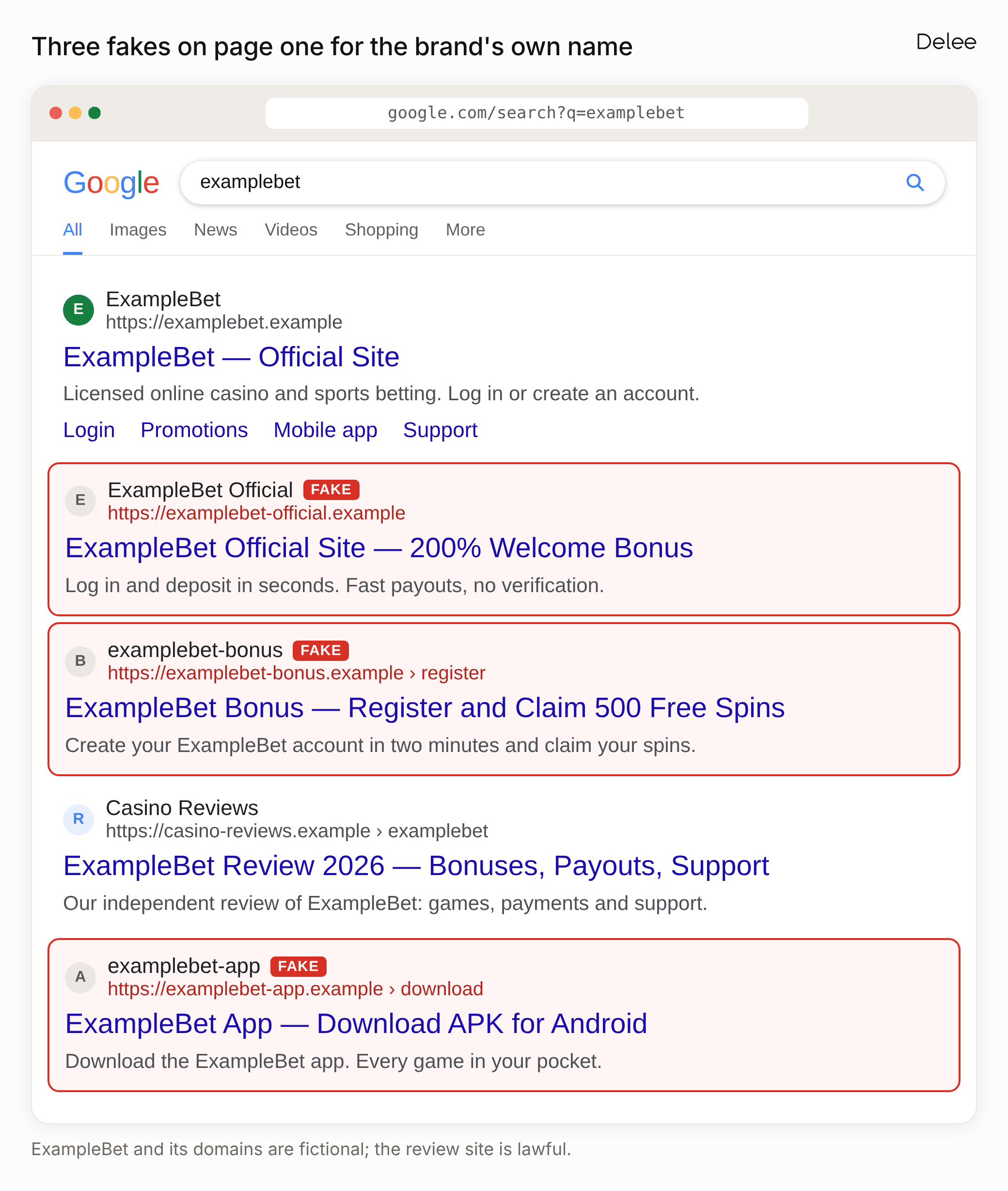
Three fakes on page one for the brand's own name; the review site is lawful
The review site is not a fake: review, comparison and approved affiliate sites may use your name. Where that line runs is in affiliate or fake.
Four ways a fake copy makes money
In 4 of 5 cases casino brands won, the fake was live
What the domain was doing when the brand filed, share of 142 WIPO decisions, cases filed in 2025
- Took deposits or posed as the brand
- 43% (61)
- Sent the brand's players to a rival
- 26% (37)
- Pushed a fake app
- 8% (11)
- Earned the brand's own affiliate fees
- 3% (4)
- Parked, for sale or empty
- 13% (18)
- Other: criticism, email fraud, ads
- 8% (11)
Source: Delee Research count of the 142 WIPO decisions casino, betting, lottery and game brands won in cases filed in 2025, read 4 November 2026. One use per decision.
It takes the deposit itself (43%). The copy shows your logo and runs its own cashier. Two such sites even claimed the gaming group Novomatic ran them (D2025-1610, D2025-2779).
It sends your players to a rival (26%). A page with Tipico's logo had a "Create an account in Tipico" link that opened a different casino (D2025-0331). In October 2026 the Dutch regulator had 26 sites removed, nearly all copies of licensed ones, that sent visitors on to an illegal casino.
It pushes a fake app (8%). A page dressed as an app store offers "your" casino app. Fake apps and fake support are covered in beyond search.
It earns your own affiliate fees (3%). The copy sends the player to your real site with its own affiliate tag. You pay commission on someone who was already looking for you.
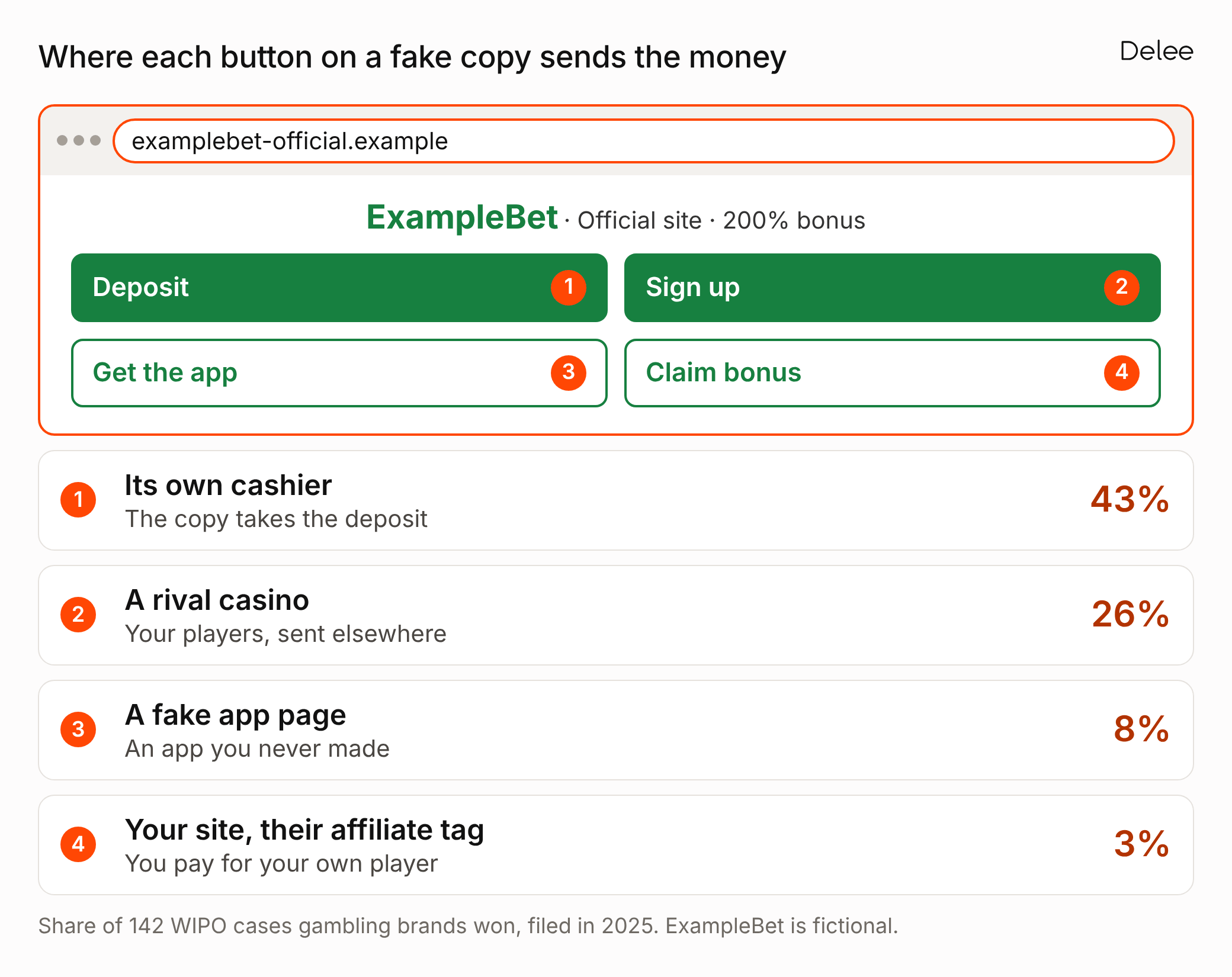
Each button on a fake copy sends the money somewhere else
Who is behind the copies
The records rarely name anyone: in 133 of the 142 cases, the owner never formally answered. A quarter of the copies sent players to rival casinos, some of them unlicensed. One owner lost cases to two different casino brands (D2025-1925, D2025-2675).
Some sit on lookalike domains, one letter off your name.
How to tell which kind you found
A few clicks, with no real login or card, show where the money goes.
Where does the money go?
Ten minutes on a suspected fake, with no real login or card
- Check it is not yoursYour own mirrors and approved affiliates are on your lists. A fake is on neither.
- Press Deposit or Log inA cashier on the same site means the copy takes the money itself. The most urgent kind.
- Press Sign upLanding on another casino means your players go to a rival.
- Press Download, then read the addressA store-like page on the copy's own domain is a fake app. Your site with an unknown affiliate tag means you pay for your own player.
Takedown notices are only for marks and content you own.
What works against each kind
- Copies that take deposits or send players away can be dropped from Google and Bing results after a notice. Reports to the host and registrar the same day can take the site offline: how to take down a fake website.
- A domain that uses your trademark can be transferred to you through a WIPO complaint. It costs USD 1,500 in fees for one to five domains with one panelist, and takes about two months.
- Fake apps and fake support are reported to the store or platform that hosts them.
- Affiliate abuse is a contract matter: affiliate terms can bar partners from domains that contain your name.
- A fake showing your licence is covered in your licence on a fake.
For your legal team. A panel transfers a domain "identical or confusingly similar" to your mark when the owner has "no rights or legitimate interests" and acted in bad faith (ICANN's dispute policy, paragraph 4(a)). It awards no damages.
What a fake copy costs you
The losses are deposits that never reach you, players who sign up with a rival, and affiliate fees paid on your own traffic. Players who lose money on a fake may complain to you; see scammed on a fake casino. A monthly figure for these losses is worked out in what fake sites cost.
Fees add up too: three brands filed 47 of the 142 cases between them. Copies return on new domains faster than one team can file by hand. Delee helps brands find fake copies of their sites in search and act on the confirmed ones as one network; see clone networks.
General information, not legal advice; ExampleBet and its domains are fictional, and case examples come from public WIPO decisions, with no Delee or client data. Delee helps brands find and remove copies of their sites. Checked against the official pages on 4 November 2026.
FAQ
Common questions
What is a casino clone website?
A fake copy of a casino's site, or a page using its name and logo, set up to take its players or their money. Review sites, approved affiliates and the brand's own mirrors are not clones.
How do fake casino sites make money?
Mostly by taking deposits themselves (43% of the 142 cases) or sending the brand's players to a rival casino (26%). Fewer push fake apps (8%) or collect the brand's own affiliate fees (3%).
Who is behind a fake casino site?
The owner is rarely named: in 133 of 142 cases the owner never formally answered. A quarter of the copies sent players to rival casinos, some unlicensed, which points to them and the affiliates they pay.
Is an affiliate or review site using our name a fake?
Usually not. Review, comparison and approved affiliate sites may use your name. A site becomes a suspected fake when it pretends to be you, or sends people who searched for you to a rival.
How much does it cost to get a fake site's domain back?
A domain complaint at WIPO costs USD 1,500 in fees for one to five domains with one panelist, before lawyers' fees. It takes about two months and covers only the domains named.
Do regulators remove fake casino sites?
Some act. The Dutch regulator had 26 sites removed in October 2026, nearly all copies of licensed operators, and Malta's regulator publishes notices naming sites that falsely claim its licence.