A Player Lost Money on a Fake Casino. Now They Blame You
The money never reached you, so there is nothing to refund. How you answer still decides what the next player thinks of you.
By Delee Research · Published · 5 min read
When a player loses money on a fake copy of your casino, the complaint comes to you: in live chat, in reviews, sometimes through your regulator.
The money never reached you. It went to whoever runs the fake, so there is nothing for you to refund.
What you control is the answer. Two quick checks show whether it was a fake, and a calm reply sends the player to the bank and the police and warns the next one.
A fake takes the money; the real brand gets the complaint. Two checks show it, and the reply points to who can still help
Key findings
- 42 of 109. Web addresses the Malta Gaming Authority checked in 2025 that falsely used its name or a licensee's (Annual Report 2025, published July 2026).
- Back to you. Regulators send players to the business first.
- One urgent case: a real customer who typed their password on a fake.
An example. ExampleBet, a fictional casino, hears from Sam, who paid EUR 200 on examplebet-vip.example and cannot see the balance.
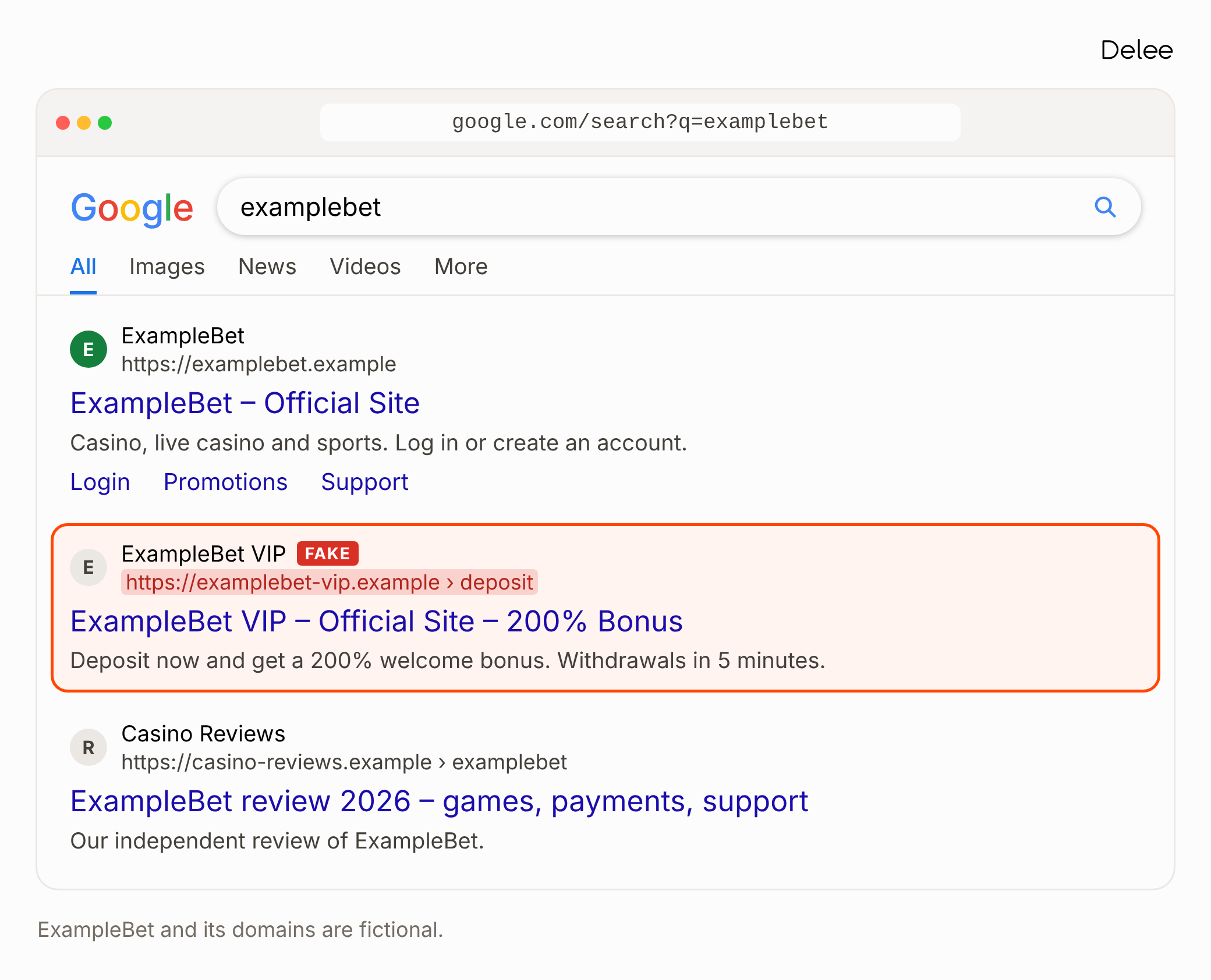
Sam searched for the brand and clicked the second result. It used ExampleBet's name, logo and colours
Why players blame the real brand
Sam searched for ExampleBet, clicked a result with its name and logo, and paid. When the balance did not appear, Sam wrote to the only ExampleBet Sam knew: the real one.
Regulators send the complaint back too. The UK Gambling Commission tells players "First of all you should complain directly to the gambling business", and "We do not resolve or make decisions on complaints".
The Malta regulator's complaint form is for complaints "against MGA-licensed operators". A player on a fake has no account with anyone licensed.
Nearly 2 in 5 web addresses the Malta regulator checked used its name or a licensee's falsely
Web addresses the Malta Gaming Authority checked in 2025
- Checked, Jan–Jun
- 75
- False references, Jan–Jun
- 34
- Checked, full year
- 109
- False references, full year
- 42
Source: Malta Gaming Authority, Interim Report January–June 2025 and Annual Report 2025 (published 7 July 2026). The full year includes the first half. Only the addresses the regulator checked, not all fake sites online.
The flagged addresses go on the regulator's public list of unauthorised URLs; more in your licence on a fake.
Was it a fake? Two checks, five minutes
Two checks before anyone replies
About five minutes, by the agent who took the complaint
- Look for the accountSearch the player's email, phone and username in your customer records.
- Get the address and the receiptThe exact web address they paid on, a screenshot and the payment receipt. The receipt names who took the money.
- Compare the address with your ownYour domains and mirrors. In Great Britain, your entry on the regulator's register lists your domains too.
| Account? Address yours? | What it is, and who acts |
|---|---|
| Yes · yours | Ordinary complaint: your normal complaints process |
| No · not yours | Fake-site victim: support, same shift |
| Yes · not yours | Customer who logged in on a fake: security team, today |
| No · yours | Typo or another name: support asks for details, checks again |
The third row is urgent: a customer who typed a password on a fake may lose their real balance next.
ExampleBet finds no account under Sam's email. The receipt names a payee that is not ExampleBet, and the address is not one of its sites: a fake.
What the player needs to hear
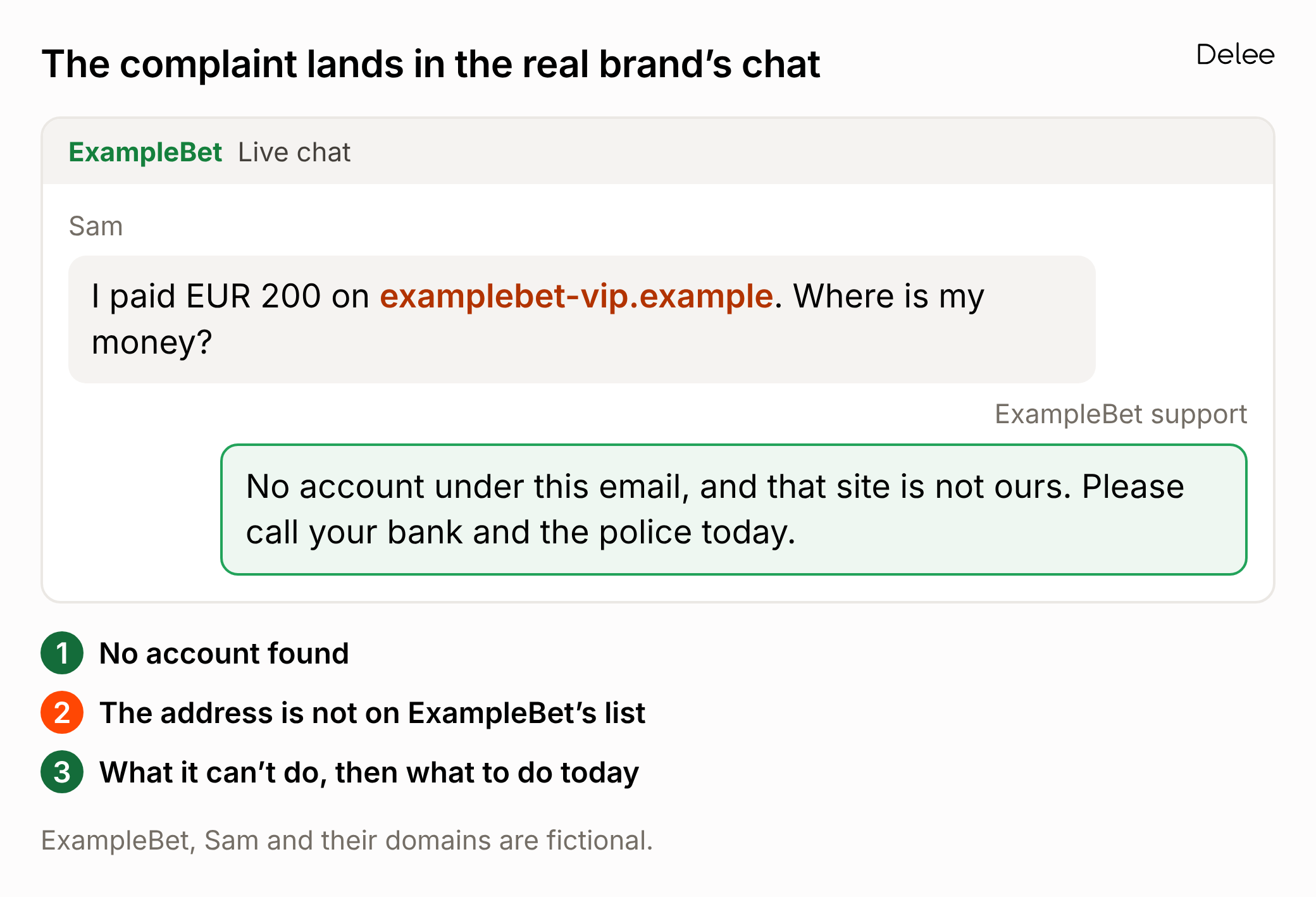
The complaint arrives in the real brand's chat, about a site it does not run
A reply that calms the player covers three things. Two are facts:
- What was checked: no account under their details, and an address that is not yours.
- Why there is no refund: the money went to whoever runs the fake and never reached you.
The third is who can still help, receipt and screenshots in hand:
- The bank, as the US Federal Trade Commission advises for a card payment: "Report it to the credit card issuer immediately."
- The police: Report Fraud in England, Wales and Northern Ireland; Police Scotland on 101 (NCSC guidance); ReportFraud.ftc.gov in the US.
- The site: UK players can send its address to the National Cyber Security Centre's scam website form.
- Not "recovery agents": the FTC says "legitimate organizations will never ask for money to help you get a refund."
A page on your site listing every real domain, mirror and app makes each reply shorter.
Answering in public
A one-star review from a scammed player is a real loss, and it stays up. Trustpilot lets a business flag a review "about a different business", but a reply keeps the warning visible. Its guidelines for businesses ask for replies that are "polite and professional", with no personal information.
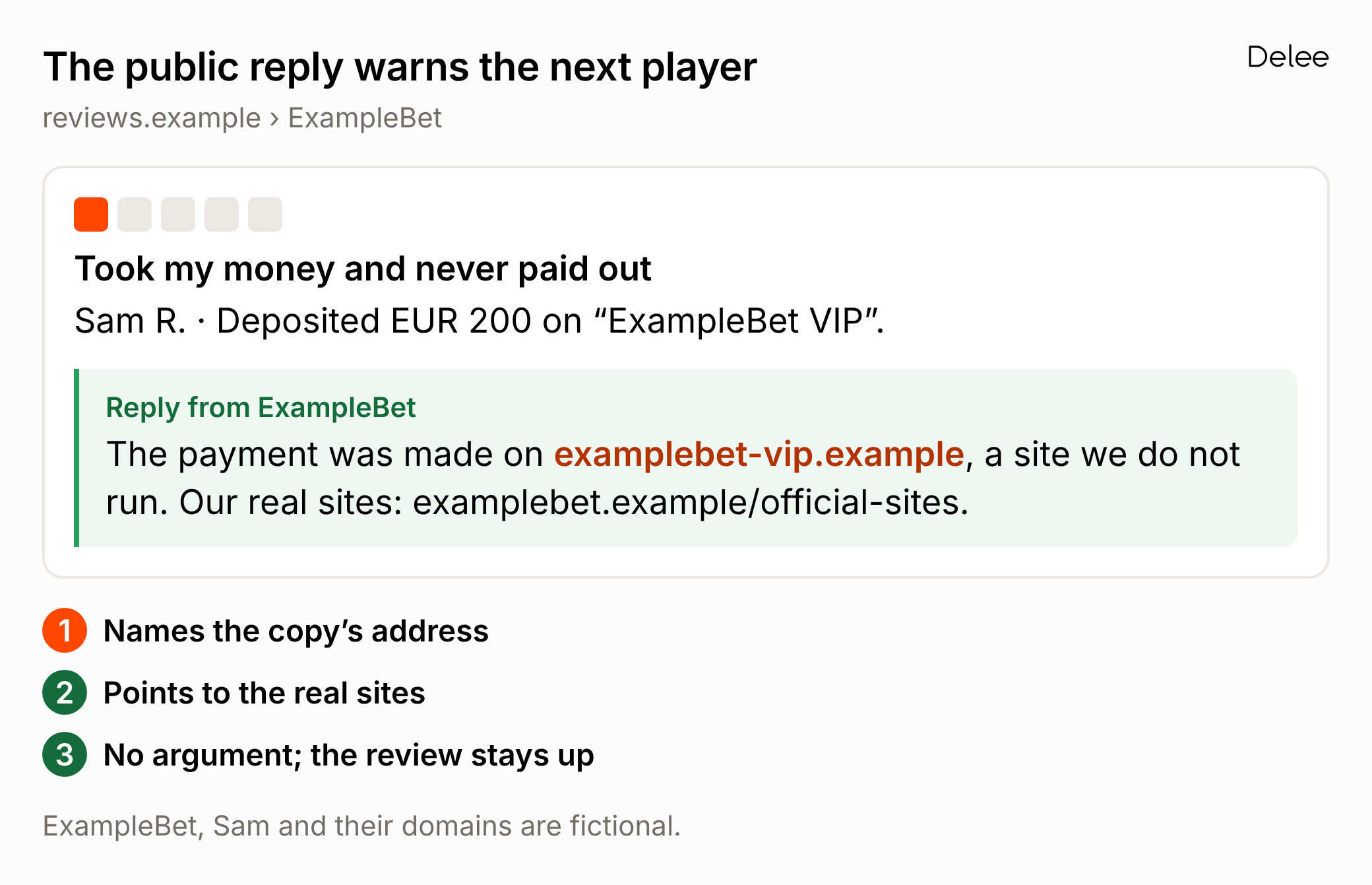
A reply that names the fake's address warns the next player
On social media, one public answer names the fake's address and says the brand never messages first.
| Backfires | Works |
|---|---|
| "This has nothing to do with us." | The site is not ours, and here is what helps |
| "We'll get your money back." | Money paid to that site never reached us |
| "Criminals at that site stole your money." | A site we do not run, which copies our name |
A regulator who asks wants facts: no account, a domain not yours, the payee on the receipt, what the player was told and where the site was reported.
The fake site itself
Every complaint carries the address of a fake taking money under your name, often before your team has seen it. Who builds these fakes is in casino clone sites.
Search engines, the host and the registrar can each act on it: see removing a fake copy. The cost is in what casino clones cost.
For your legal team.
- Whether a report about a site you do not run counts as a complaint under your licence is a compliance question. Logging each one, with the domain and date, costs nothing.
- "A site we do not operate" accuses no one. Neither a refund nor a removal is yours to promise.
Delee helps brands find fake copies of their sites in search and file against the confirmed ones; see fake sites in search.
General information, not legal advice; ExampleBet, Sam and their domains are fictional. Delee helps brands find and remove copies of their sites; no Delee or client data is used here. Checked against the official pages on 4 November 2026.
FAQ
Common questions
A player was scammed on a fake site using our name. Do we have to refund them?
There is nothing to refund: the deposit went to whoever runs the fake site and never reached you. What helps the player is their bank, the police and a report of the site, the same day.
How can support tell a fake-site victim from a real customer complaint?
Two checks, about five minutes: search your records for the player's email or phone, and compare the web address they paid on with your own domains. No account and an address that is not yours means a fake.
Should we ask Trustpilot to remove a review written by a scammed player?
Trustpilot lets a business flag a review "about a different business", but a public reply does more for the next reader. It says the site was not yours, where your real sites are listed and what the player can do.
Where should a scammed player report a fake casino site?
To their bank or card issuer first, then the police: Report Fraud in England, Wales and Northern Ireland, Police Scotland on 101, ReportFraud.ftc.gov in the US. UK players can also report the website to the National Cyber Security Centre.
Will the regulator handle a complaint about a fake site that copies us?
Not as a dispute. The UK Gambling Commission does not resolve individual complaints, and the Malta Gaming Authority's complaint form covers its licensees. A fake's victim has no account with anyone licensed.