Affiliate or Fake? One Button on the Page Tells You
Most sites that use your casino's name are lawful affiliates. In Britain, the ones that break the rules are still your problem: the operator answers for the affiliates it pays.
By Delee Research · Published · 4 min read
Press the main button of a site that uses your casino's name. If it lands on your own domain, the site is an affiliate, paid a commission for each player it sends you. If the page asks for a login, card or deposit itself, it is a fake, built to take players' money and passwords.
Two cases sit in between: your own affiliate calling itself your "official site", and pages that use your name to send players to another casino.
A fake goes to your brand or legal team for removal. In Britain, an affiliate's mistakes are your compliance problem: the operator answers for the affiliates it pays.
Press the main button and watch the address bar: your own domain means an affiliate, a form on the page means a fake
Key findings
- £300,000. The UK Gambling Commission's first fine for advertising failings (2017) covered misleading ads on the operator's own site and its affiliates' sites.
- No keyword ban. Google Ads does not stop anyone bidding on a trademark as a keyword. For your own affiliates, the contract can.
- Reviews are lawful. Naming a casino to review or compare it does not infringe its UK trade mark (Trade Marks Act 1994, s.11(2)(c)).
Where the button goes tells you who runs the site
ExampleBet, a fictional casino licensed in Britain, searched its own name. Four sites below its own used the name.
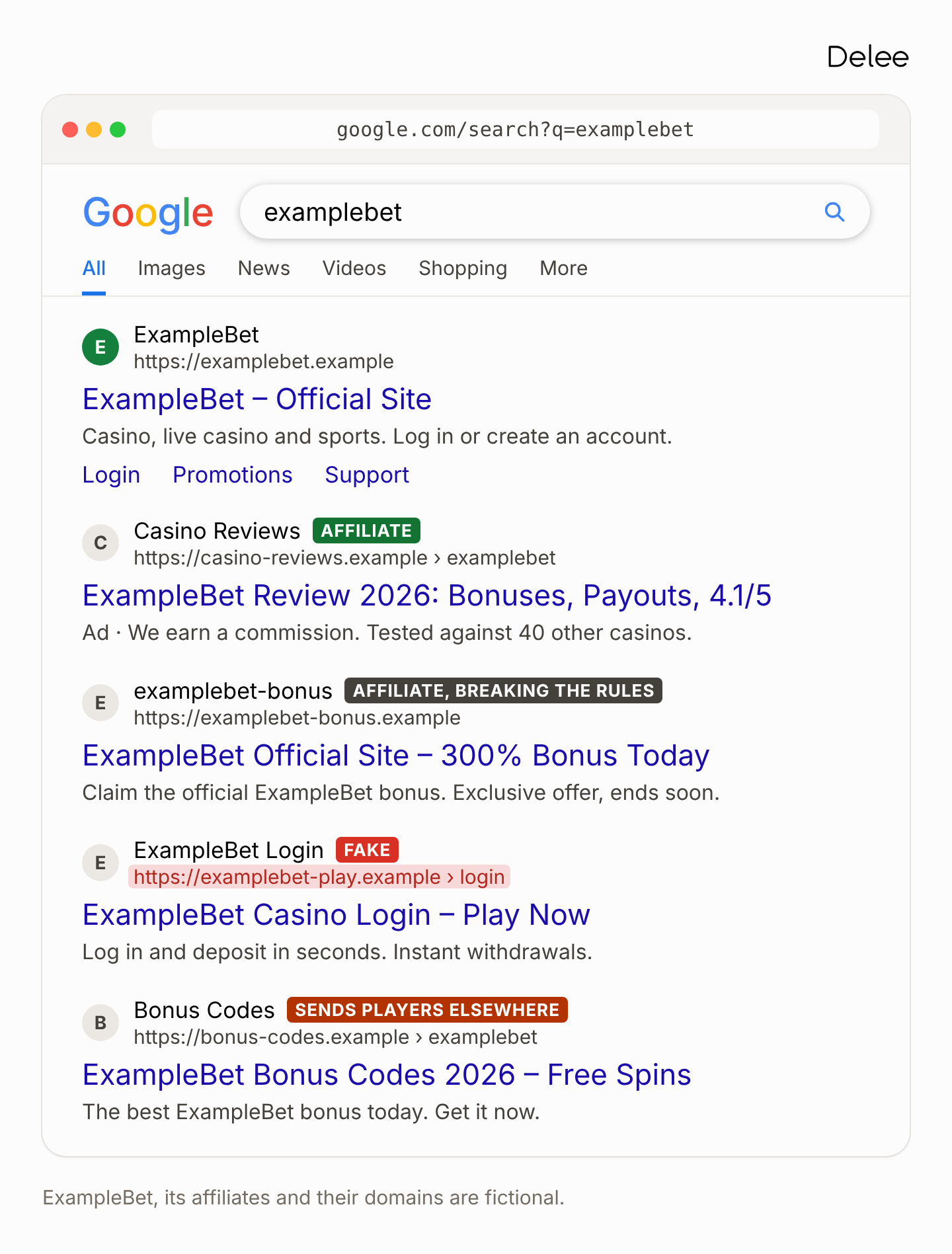
One search for the fictional ExampleBet: an affiliate, an affiliate breaking the rules, a fake and a page that sends players elsewhere
Each main button sorted them:
| Where the button goes | What the site is | Who acts |
|---|---|---|
| Your domain, often with a tracking code | An affiliate | Nobody |
| Your domain, but the page says "official" | Your affiliate breaking your rules | Affiliate manager |
| Nowhere: a login or deposit form | A fake, usually phishing | Brand or legal |
| Another casino's domain | A page using your name for a rival | Brand or legal |
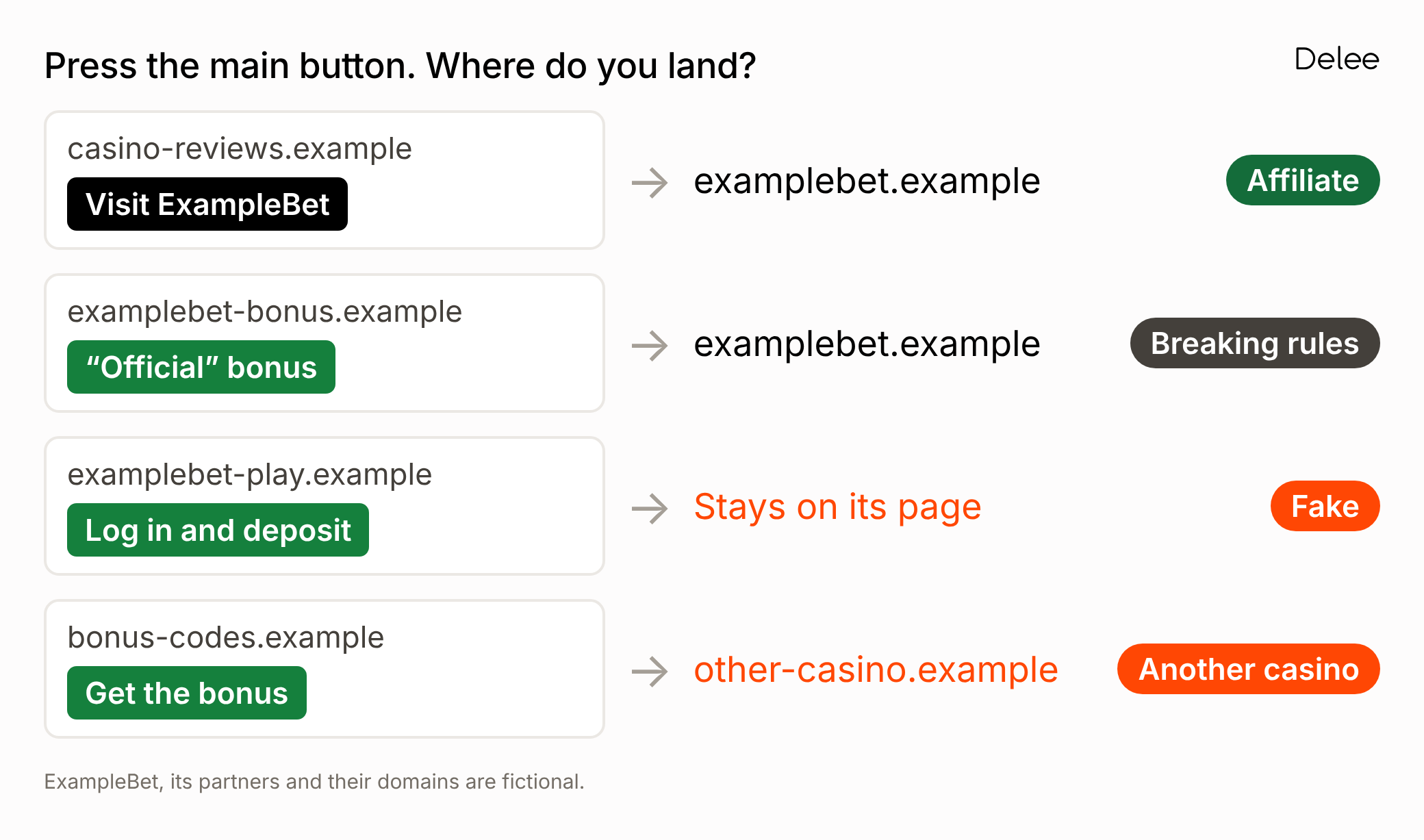
Two buttons land on the brand's own domain; one keeps the money on its page; one sends players to another casino
Review sites are allowed to use your name
Naming a casino to review, rate or compare it is lawful. Most affiliates on a brand search are review sites.
- Under section 11(2)(c) of the UK Trade Marks Act 1994, honest use of a mark to refer to the owner's goods or services does not infringe it.
- Google's spam policies say "Not every site that participates in an affiliate program is a thin affiliate".
A review that outranks you is a search problem, not a legal one. A takedown notice against it would be a false notice, and the legal risk falls on the sender.
When your own affiliate goes too far
The hard cases are real affiliates that send real players and still break the rules. The signs are on the page:
- it calls itself "official", or shows only your name and logo;
- it looks like a news story, with no clear ad label;
- it shows a bonus you do not offer, or one that has ended;
- it bids on your name in search ads against your terms;
- it is a former partner still using your logo.
ExampleBet's "Official Site" page came from its own affiliate, with a 300% bonus that had ended. A written notice with a seven-day deadline was enough: the affiliate renamed the page and paused its ads.
Why your affiliate's mistakes are your problem in Britain
In Britain, the casino answers for the affiliates it pays. The Gambling Commission's code 1.1.2 applies to every licence, and a breach can lead to a licence review or a fine.
- The Gambling Commission. Its first fine for advertising failings, £300,000 in May 2017, covered misleading ads "on its own and its affiliates’ websites".
- The advertising regulator (ASA). In a 2017 ruling against 888 UK, it held the operator responsible for an affiliate's ad "as the beneficiaries of the marketing material".
For your legal team.
- Code 1.1.2(1): "Licensees are responsible for the actions of third parties with whom they contract for the provision of any aspect of the licensee’s business related to the licensed activities."
- Under 1.1.2(2), the contract must let the licensee end it promptly if the third party breaches it, "including for affiliates where they have breached a relevant advertising code of practice."
Bidding on your brand name: Google allows it
Brand bidding is an affiliate paying for search ads on your name, to earn commission on players already looking for you. Google's trademark policy lists "Using trademarks as keywords" among things Google Ads "will not restrict". It does restrict ads "that use the trademark in a confusing, deceptive, or misleading way", so an "Official site" ad can be reported.
Fakes and pages that send players to a rival
The fake ExampleBet login page went straight to the brand team. The routes that remove it are in how to take down a fake website.
The bonus-codes page sent players to another casino. ExampleBet told that casino's affiliate team; a British licensee answers for that affiliate under the same code 1.1.2.
Checking every market and new domain each week by hand does not scale. Delee helps brands find the sites ranking on their name, set approved affiliates aside and act on the fakes; see fake sites in search.
How copies of casino sites make money is in our guide to casino clone sites; for fakes that show a licence number, see your licence on a fake.
General information, not legal advice; ExampleBet, its affiliates and its domains are fictional. Delee helps brands find and remove copies of their sites; no Delee or client data is used here. Checked against the official pages on 4 November 2026.
FAQ
Common questions
How do I tell an affiliate site from a fake casino site?
Press its main button. An affiliate sends you to the casino's own domain; a fake asks for your login, card or deposit on its own page.
Are casino review and comparison sites legal?
Yes, when done honestly. Section 11(2)(c) of the UK Trade Marks Act allows honest use of a mark to refer to the owner's goods or services.
Is a casino responsible for what its affiliates publish?
In Britain, yes. The Gambling Commission's code 1.1.2 makes licensees responsible for the third parties they contract with, affiliates included.
Can I stop affiliates bidding on my brand name in Google Ads?
Not through Google: its trademark policy does not restrict trademarks as keywords. The affiliate contract can forbid it.
What if my own affiliate calls itself my official site?
It is a contract breach, not a takedown case. A written notice with a deadline comes first; under code 1.1.2 the contract must let you end the deal if the page stays.