The DMCA Counter-Notice Gets Your Page Back, at a Price
A counter-notice usually brings the page back. It also gives your name and address to whoever filed the claim, and accepts a US court.
By Delee Research · Published · 5 min read
When Google removes your own page over a false copyright claim, a DMCA counter-notice is the usual way back. Google restores the page if the sender does not go to court within 10 business days.
The DMCA is the US Digital Millennium Copyright Act. The price: a counter-notice gives the sender your name, address and phone number, and accepts a US court. In 2023 Google sued over one scheme it said got over 100,000 businesses' websites removed from its results.
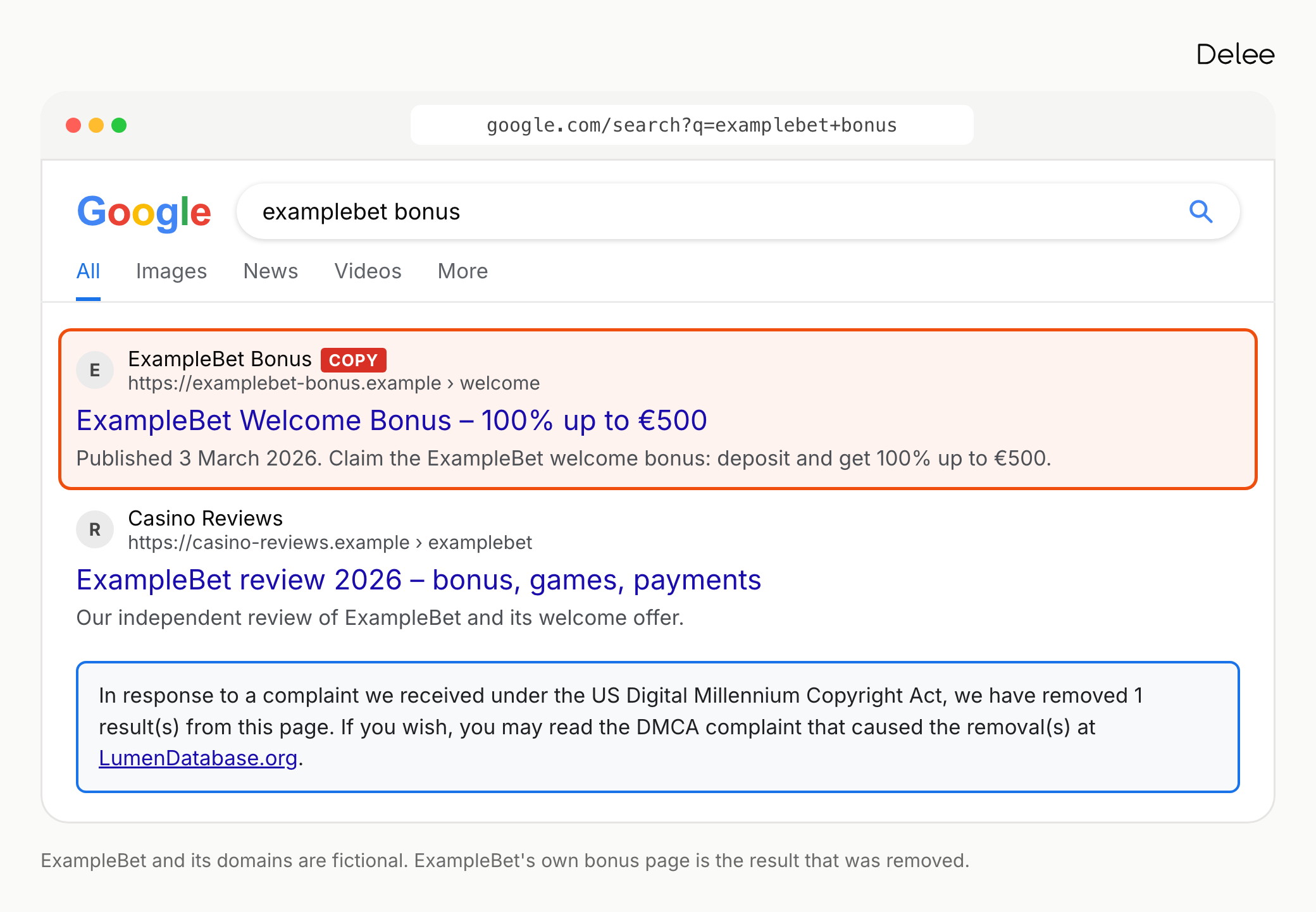
Where your page was, Google shows one line and a link to the complaint
Key findings
- 10 business days. The shortest wait before Google restores a page after a counter-notice; US law allows up to 14 (17 U.S.C. §512(g)).
- 100,000+. Businesses' websites removed from Google by one scheme of bogus copyright claims, by Google's own count (November 2023).
- Name, address, phone. What a counter-notice gives the person who filed the claim.
The example in this guide. ExampleBet, a fictional casino, finds its welcome-bonus page gone from Google for "examplebet bonus". A copy of the page on another domain now ranks first.
How do you know a page was removed?
Google notifies site owners registered in Search Console, its free site dashboard, says its copyright removal FAQ, but the notice does not always arrive. Search your brand: where the page was, the results show one line linking to the complaint.
The complaint sits in Lumen, a public archive of removal notices sent to Google and others. Its public page may show only your domain and a count of addresses; Lumen releases the full notice on request. The complaint against ExampleBet names the copy as the original, dated a week before ExampleBet's own page.
Is the claim false, or did they have a point?
A counter-notice is a sworn statement that the page was removed by mistake. Filed for content you copied, it is a false statement under penalty of perjury.
| What the complaint says | What it probably is | Counter-notice? |
|---|---|---|
| Your own text was copied from the sender | A false claim, often a dated copy | Yes, with proof of date |
| You used their text or images without a licence | They have a point | No: remove or license it |
| Licensed text, such as a game supplier's | A mistake, probably | Ask them to retract first |
| The sender uses a regulator's name | Probably a false claim | Yes, if Lumen lists it as a copyright (DMCA) complaint |
Who sends false claims, and why
Often rivals, sometimes people silencing a critic. In 2023 Google sued people who it said "set up dozens of Google accounts and used them to submit thousands of bogus copyright claims against their competitors".
Gambling sites get them too. In June 2025 CasinoBeats reported "spurious copyright claims, and fraudulent government requests" against gambling affiliates, some sent in the name of "The Gambling Commission". It also described a "back-dating" tactic: the sender republishes your page with an earlier date and reports your original as the copy.
The tactic is cheap. In 2026 two Press Gazette stories about a casino SEO company vanished from Google after complaints the outlet called false; both "were reinstated after a few days". An iGaming SEO executive told it: "we are seeing thousands of these a day".
Three ways back, compared
| Route | How long | What it costs you |
|---|---|---|
| Ask the sender to retract | As fast as they act | Nothing, but only a real sender can do it |
| Counter-notice to Google | 10–14 business days, unless sued | Your name, address and phone go to them |
| Leave it | The page stays out | Branded traffic, and possibly lower rankings elsewhere on the site |
Google accepts a retraction only from the original complainant, its page on resolving copyright complaints says. Against a sender who does not exist, we would file the counter-notice.
Leaving it has a second cost. Google's spam policies say "a significant volume of valid copyright removal requests" can lower a site's other pages. Google does not say whether a claim nobody disputes counts as valid.
Filing the counter-notice, step by step
Getting a wrongly removed page back into Google
ExampleBet's bonus page, a fictional case
- Read the complaint in LumenFollow the link in the results or in Search Console, and request the full notice. You get the exact addresses removed and the page the sender calls the original.5 minutes
- Save proof your page came firstYour site's publishing history, an archived copy in the Internet Archive's Wayback Machine, dated screenshots. You get one folder that shows your date.5 minutes
- File Google's counter-notice formOne form for the removed addresses, signed under penalty of perjury. Google reviews it and forwards it to the sender.
- Wait 10 business daysIf the sender starts no court case, Google restores the page. ExampleBet's returned 15 calendar days (11 business days) after filing.
- Search your brand againThe page is back in the results. A new claim from the same sender starts from the same folder.
Source: Google Legal Help Center; 17 U.S.C. §512(g). ExampleBet is fictional.
The first two steps take about ten minutes and are worth doing whatever you decide. Google's counter-notice form is reached from its Legal Help Center.
What a counter-notice costs you
The sender learns who you are. Google forwards the counter-notice, with your name, address and phone number, and warns that "filing a counter notice may lead the complainant to initiate legal proceedings against you."
For a casino licensed outside the US, the form also accepts a US federal court. That is a decision for counsel, not for the SEO team.
For your legal team.
- Consent. §512(g)(3)(D): a counter-notice includes a statement that the subscriber "consents to the jurisdiction of Federal District Court for the judicial district in which the address is located, or if the subscriber's address is outside of the United States, for any judicial district in which the service provider may be found".
- Timing. §512(g)(2)(C): restored "not less than 10, nor more than 14, business days following receipt of the counter notice", unless the sender files a court action.
- False statements. §512(f) also covers anyone who knowingly misrepresents that material "was removed or disabled by mistake or misidentification".
- Full text: 17 U.S.C. §512.
When the claims keep coming
A backdated copy is itself a fake copy of your site; reporting one has its own guide, and how fake casino sites make money explains why they appear.
One false claim can be handled by hand; a stream of copies cannot. Delee helps brands find fake copies of their sites in search and report the confirmed ones; see fake sites in search.
General information, not legal advice; ExampleBet and its pages are fictional, and no Delee or client data is used here. Checked against the official pages on 17 November 2026.
FAQ
Common questions
What is a DMCA counter-notice?
A sworn statement asking a platform to restore content it removed after a copyright claim, because the removal was a mistake. The platform then restores it within 10 to 14 business days under US law, unless the claimant sues.
How long does a counter-notice take on Google?
At least 10 business days. Google forwards the counter-notice to the claimant and restores the page if they start no legal proceedings within 10 business days.
Does the person who filed the claim see my details?
Yes. The counter-notice carries your name, address and phone number, and Google forwards it to the claimant.
Can a company outside the US file a counter-notice?
Yes. It consents to a US federal court in any district where the platform may be found, and agrees to accept legal papers from the claimant.
What if the claim was right?
Then a counter-notice would be a false statement made under penalty of perjury. Remove or license the content instead.